TUI
Building an end-to-end co-creation team for fast results and a tangible conversion boost
Independent Co-Creation Studio
Team 300 brings together all required roles in an end-to-end team with its own decision-making authority. The neutral environment outside the usual TUI corporate structures creates space for focused work, fast coordination and pragmatic results.
Data-driven design decisions
Design decisions are data- and user-driven, through continuous testing and validation. An A/B test shows this measurably: a comparison feature in the wishlist increases conversion by 15 per cent, because only features with real value for users and the business are developed.
Circle organisation with connection to the line organisation
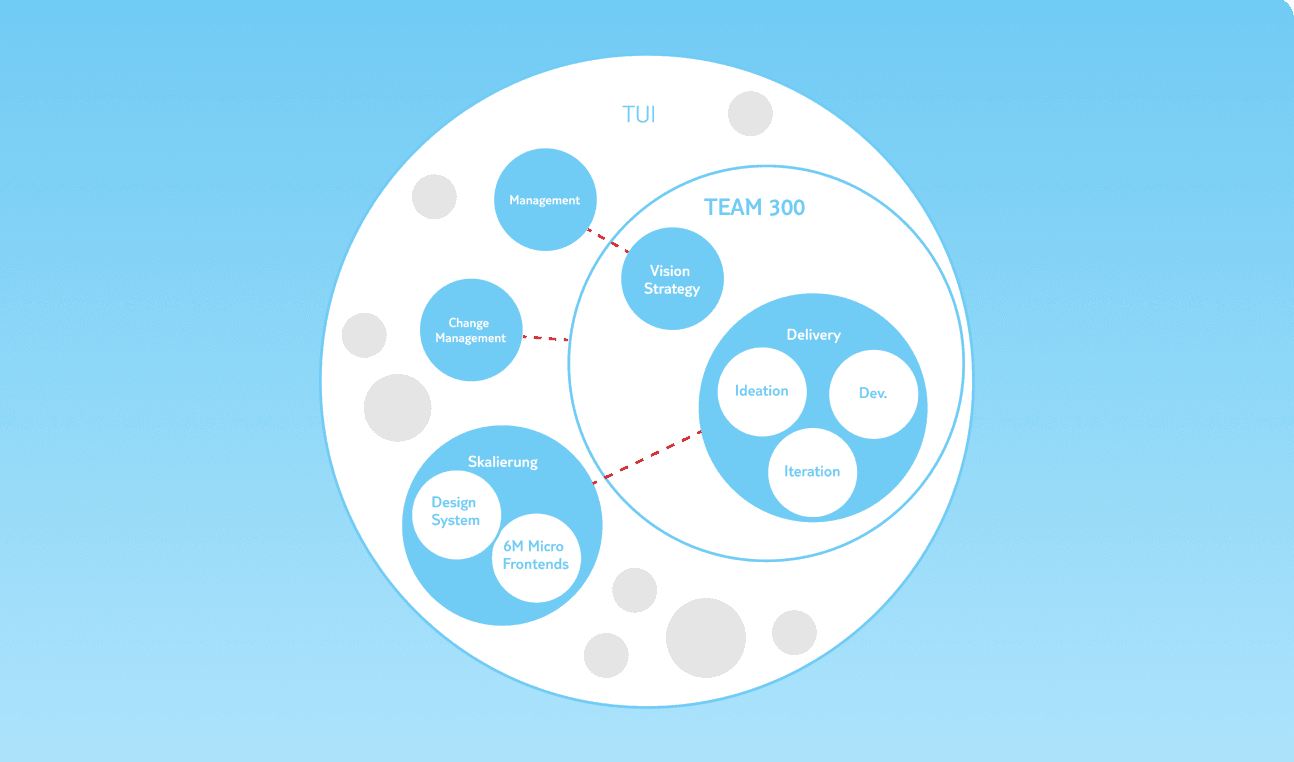
The self-organised team structure ensures clear accountabilities, high ownership and short paths to delivery. At the same time, it guarantees integration with existing TUI processes, so that results and ways of working persist beyond the end of the project.
DIaaS® as a shared design and consultancy standard
DAYONE’s design and consultancy standard DIaaS®, Design Innovation as a Service, combines collaborative ways of working, strategic thinking and user-centred design. A clear mission, the right experts and openness to new approaches lead to tailored solutions for TUI.
TUI, Europe’s largest tourism group, saw rising mobile traffic, but booking conversion on mobile devices lagged behind desktop. Together with TUI, DAYONE set up the co-creation studio Team 300 and redesigned the mobile booking process in a data-driven way. An A/B test shows: a comparison feature in the wishlist increases conversion by 15 percent and is now permanently embedded in Team 300 within the TUI organisation.
- Client
- TUI · Europe’s largest tourism group
- Industry
- Tourism / travel
- Services
- Co-Creation Setup · UX/UI Design · Design system · Knowledge transfer & enablement
- Outcome
- +15 % conversion from a comparison feature in the wishlist (A/B test)
Starting point
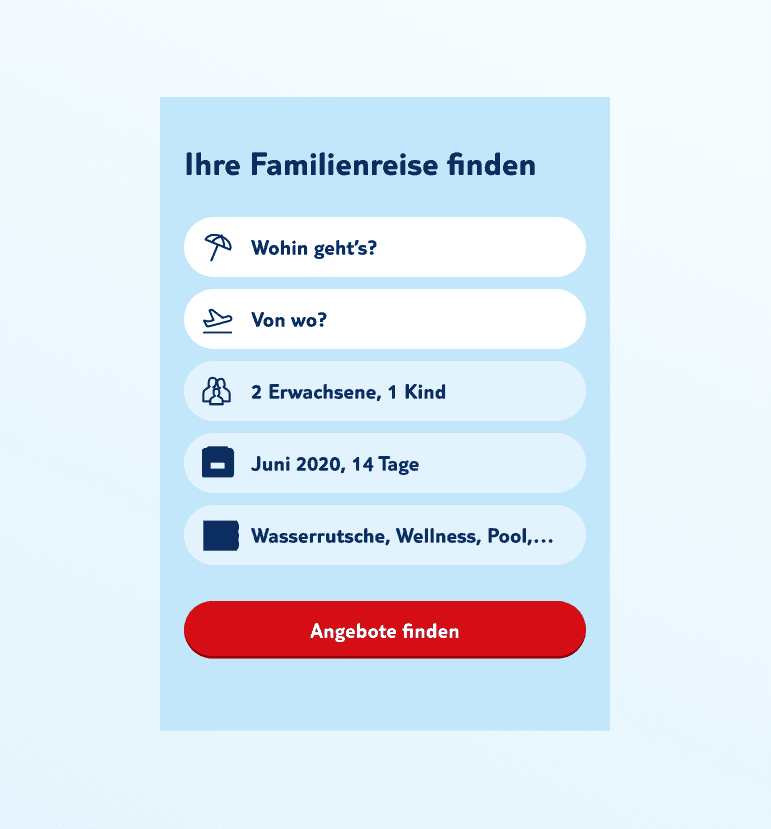
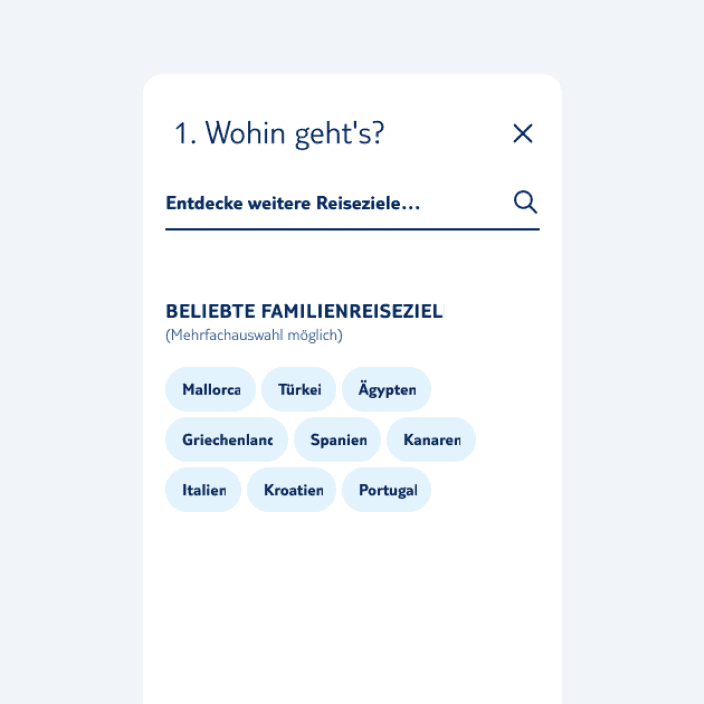
TUI was seeing growing mobile traffic, but package booking conversion on mobile devices lagged behind that on desktop.



An end-to-end team with 13 clearly defined roles
Team 300 fills 13 roles along the entire value chain: Business Owner, Product Owner, UI Design, UX Design, Special Agent, Experience Strategy, Team Assistant, Communicator, Agile Coach, Researcher, Admin, Fullstack Dev and Challenger. Each role carries its own responsibility, enabling the team to make decisions without referring back to the line organisation.

A comparison feature in the wishlist as a validated feature
Rather than building on assumptions, Team 300 tested individual hypotheses in live operation. An A/B test showed that a comparison feature in the wishlist helps users weigh up travel options and increases conversion by 15 per cent. Only this evidence determined the rollout.

A design system for mobile, desktop and tablet
DAYONE built a flexible design system with reusable components for mobile, desktop and tablet applications. It keeps the booking process consistent across all devices and reduces the effort for new features, because components are reused instead of being redesigned.
Circle organisation: seamless link to the line organisation
The self-organised team structure provides clear responsibilities and fast delivery paths within Team 300. At the same time, the circle organisation connects the team to existing TUI processes, so that knowledge, frameworks and outcomes remain within the TUI organisation beyond the project.
Outcome
+15 %
Conversion uplift from the wishlist comparison feature
Method: A/B test (not further specified on the live page, e.g. sample size or test duration unknown)
After the collaboration ends, Team 300 remains connected to the TUI line organisation as a self-organised unit, with defined interfaces to existing processes rather than an isolated project structure.
Our Contribution During the 8 Months of Team 300
With our design and consulting standard DIaaS® (Design Innovation as a Service), we combine collaborative workflows, strategic thinking, and user-centered design. This approach leads to tailored solutions through clear missions, the right experts, and openness to new ideas.
Co-Creation Setup
Establishment and facilitation of an independent, interdisciplinary studio to promote fast, innovative product development outside corporate structures.
User-Centered UX Design
Development of a hypothesis-based design process and conception of an optimized, scalable mobile booking experience.
Design System Development
Creation of a flexible design system with reusable components for mobile, desktop, and tablet applications.
Knowledge Transfer & Enablement
Anchoring frameworks, methods, and results within the TUI organization as a foundation for long-term product development and innovation. The self-organized team structure ensured clear responsibilities, high levels of accountability, and fast implementation paths. At the same time, the integration with existing TUI processes was ensured, making the results sustainable and scalable.
Frequently asked questions
How is a conversion optimisation in the booking process validated before it is fully rolled out?
A hypothesis first runs as an A/B test against the existing version before it is rolled out broadly. In TUI’s booking process, such a test showed that a comparison feature in the wishlist increases conversion by 15 per cent. Only that evidence determines the full rollout, not the original idea.
What is a co-creation studio, and how does it differ from a classic project team?
A co-creation studio like Team 300 brings together all required roles in an end-to-end team with its own decision-making authority, instead of spreading tasks across multiple departments. The neutral environment outside the usual corporate structures allows rapid coordination and focused work. The team makes decisions itself and does not need to obtain approvals through multiple line levels.
How does a self-organised team like Team 300 stay connected to the existing corporate organisation?
Through a circle organisation: clear responsibilities within the team create short paths to delivery, while defined interfaces ensure integration with existing TUI processes. This way, results and ways of working remain embedded in the organisation after the project ends.
What distinguishes conversion optimisation from a pure redesign?
Conversion optimisation changes individual elements of an existing user journey and tests their impact, rather than redesigning the whole experience. What matters is which single change demonstrably leads more people to complete a booking, not how much is rebuilt.


Let's move your project forward together!
We look forward to your challenge.