Deutsche Bahn
Digital ordering service on ICE increases order volumes and improves on-board service processes
Process optimisation
Optimising the digital ordering service on ICE and seamlessly integrating it into the on-board staff’s daily workflow.
Customer Experience in Focus
Increasing traveller satisfaction through significantly higher service availability and shorter waiting times.
Business Impact
Increase in orders thanks to higher service availability and optimised process flows.
Inclusive Design
Compliance with all EU guidelines for digital accessibility in line with WCAG standards.
Deutsche Bahn offers First Class travellers on ICE a digital at-seat ordering service for food and drinks. Activation, galley and stock checks ran through complex processes with limited availability. DAYONE optimised the ordering service through user-centred service design and a new staff app. The result: more orders, higher availability, and a BFSG-compliant, accessible interface.
- Client
- Deutsche Bahn
- Industry
- Mobility & Rail Transport
- Services
- Service Design · User Research · UI Design · Accessibility · Prototyping · Implementation · Conversion Optimisation · Internal Tools
- Outcome
- More orders, higher availability, BFSG-compliant accessibility
Starting point
Activating the ordering service and checking the on-board galley and stock levels ran through complex, slow processes. This limited the digital ordering service’s availability on ICE and thus the number of orders.
Streamlined processes deliver significantly higher service availability
Activating the ordering service, and checking the on-board galley and stock levels, have been simplified. This makes the process faster and more reliable, resulting in a marked increase in service availability. The staff app’s intuitive interface gives the crew an overview of all orders and alerts them immediately when action is required or errors occur, enabling a quick response.
Order at your seat: Convenient food and drink directly via the ICE Portal
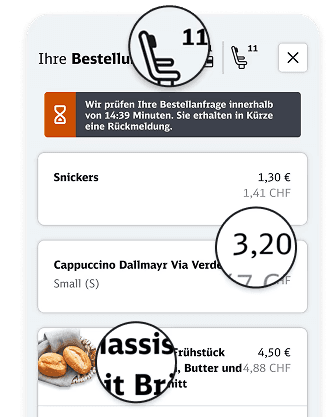
In the ICE Portal, travellers see the current menu with direct ordering. The easy access saw strong uptake and increased the on-board service’s monthly revenue. The service offering meets First Class expectations.


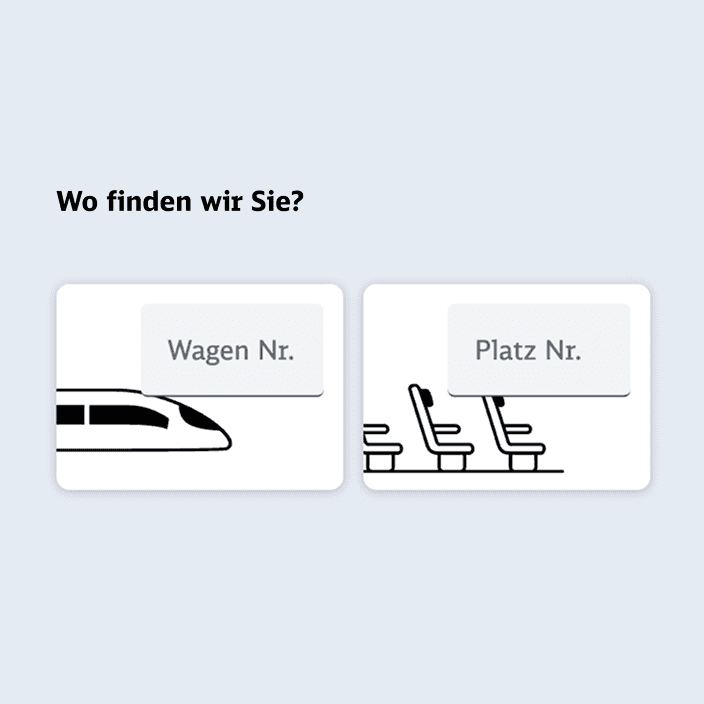

Accessible Design: Digital accessibility for all travellers
The user-centred design approach makes the digital ordering process accessible and intuitive for all travellers. The interface design meets AA guidelines and thus the requirements the Accessibility Strengthening Act (BFSG) has mandated for digital products since June 2025.
Outcome
Following optimisation, the digital ordering service on ICE is used more often, with higher availability and shorter waiting times for First Class travellers.
The number of on-board service orders has risen, and monthly revenue from the ordering service has increased.
The ordering service interface meets AA guidelines and thus the requirements the Accessibility Strengthening Act (BFSG) has mandated for digital products since June 2025.
The new staff app gives the crew an overview of all orders and instantly flags when action is required or errors occur.
Our contribution to improving the at-seat ordering service
With our design and consulting standard DIaaS® (Design Innovation as a Service), we combine collaborative workflows, strategic thinking, and user-centered design to create tailored, future-proof solutions.
User Research
Comprehensive identification of the needs of staff and passengers as well as existing processes to create data-driven, targeted solutions.
Practical Idea Development
Joint development and direct feasibility testing of concepts for actionable and effective solutions.
Intuitive UI Design
Design of a user-friendly interface that takes all user groups into account, including accessible use according to EU guidelines.
Iterative Prototype Testing
Continuous validation of the developed solutions through user testing and feedback loops to ensure quality.
Implementation Support
Step-by-step integration of the solutions into the ICE portal and existing IT systems to ensure a smooth rollout.
Frequently asked questions
What distinguishes Service Design from traditional UX design?
Service Design shapes not just individual screens, but the entire journey across multiple touchpoints, for example in the ICE both the ordering interface for passengers and the staff app for on-board personnel at the same time. UX design, by contrast, usually optimises a single digital touchpoint.
How are digital and physical touchpoints in a service designed consistently?
Digital interfaces such as the ICE Portal and physical processes such as checking the on-board galley are designed as one continuous process, not in isolation. This way, ordering, preparation and delivery to the seat interlock rather than breaking at handovers.
Why does Service Design for an on-board service consider both travellers and staff?
An ordering service only works if both sides can use it: travellers need simple at-seat ordering; the on-board crew need an overview that brings together orders, galley and stock. Service Design therefore designs both interfaces within the same process.
How is accessibility under BFSG and WCAG built into an existing digital service?
The interface design is checked against the WCAG AA guidelines and adapted accordingly, from contrast and keyboard operability to clear error messages. This meets the requirements that the Accessibility Strengthening Act has required for digital products in Germany since June 2025.


Let's move your project forward together!
We look forward to your challenge.