Humboldt Forum
More than 6,500 exhibits digitally accessible, curatorially presented and interactive worldwide.
Digital Extension of the Educational Mission
Museum objects are accessible worldwide, regardless of location or mobility.
Sustainable Digitalisation
Over 6,500 objects have been catalogued and scientifically documented to preserve historical collections for the long term.
Interactive Experiences
Digital features such as 3D models, quizzes and thematic maps encourage active engagement with the objects.
The Humboldt Forum, one of Germany’s most popular museums, managed collection data dispersed across museums, archives and depots. With Sammlungen Online, DAYONE built a digital museum catalogue that makes over 6,500 exhibits multilingual, accessible and interactive, with search, filters, 3D models and thematic maps. The result: museum objects reachable worldwide, regardless of location or mobility.
- Client
- Humboldt Forum · one of Germany’s most popular museums
- Industry
- Public culture / museum
- Services
- UX research · UX/UI design · information architecture · accessibility · MVP development · development · digital strategy
- Result
- Over 6,500 exhibits available digitally, multilingual, interactive and accessible
Starting point
The Humboldt Forum’s collection data was distributed across different museums, archives and depots, inconsistently documented and not centrally searchable or accessible for visitors.
Central platform for a wide range of collections
Sammlungen Online brings together records from museums, archives and repositories into a central digital museum catalogue. By harmonising disparate data sources, it creates a consistent, interactive presentation of over 6,500 objects. Users search, compare and place them in new contexts. The structured curation of these records enables precise filters and an intuitive search.


Interactive detail pages for a deeper experience
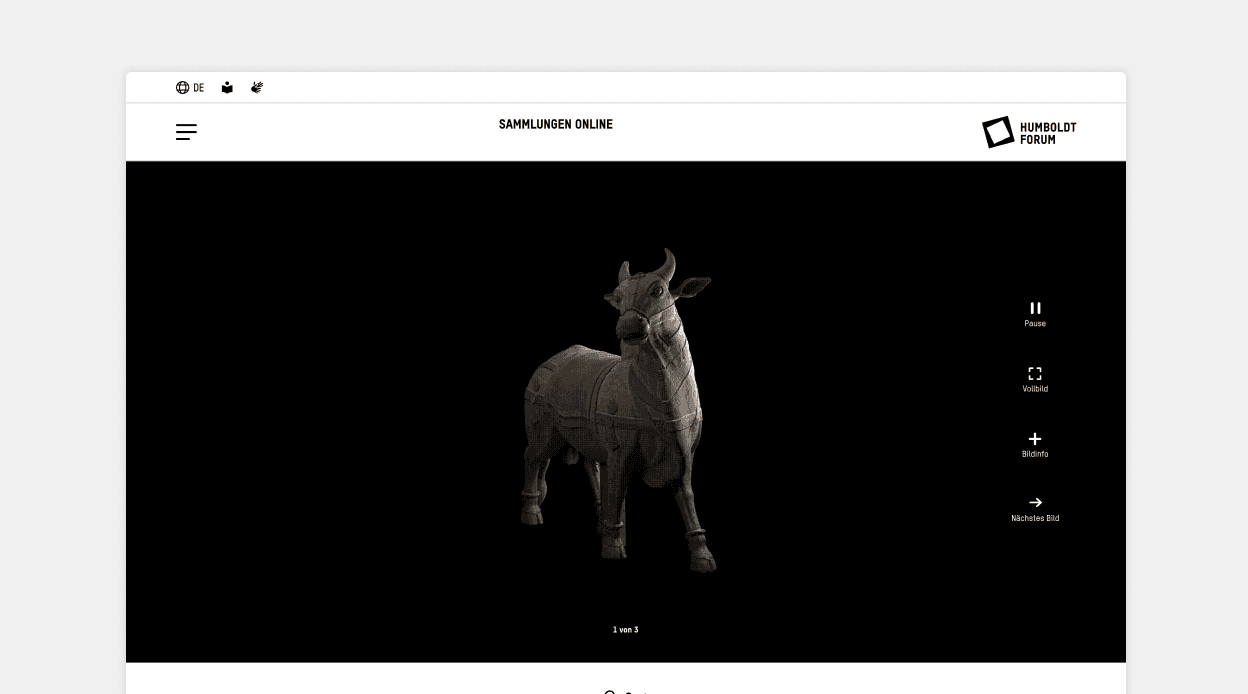
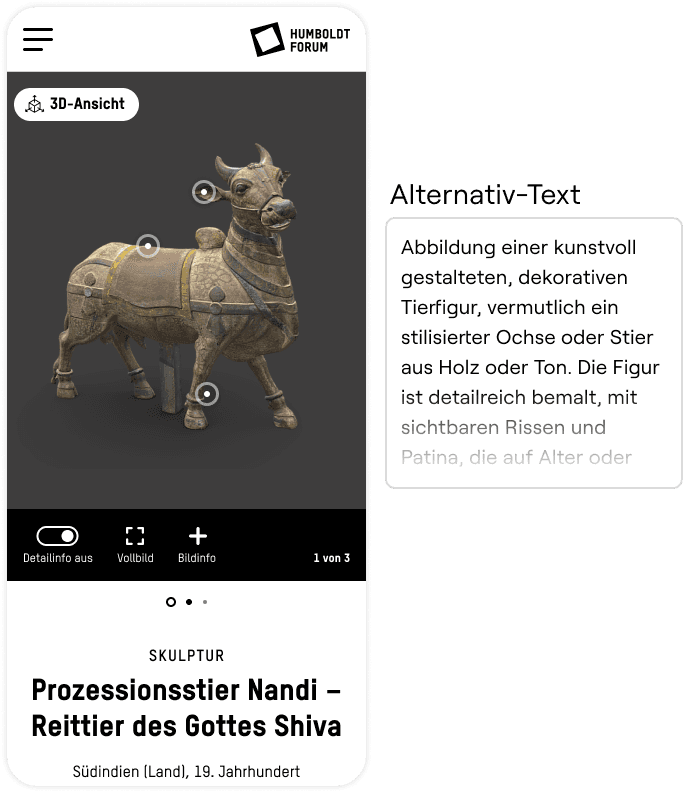
Each object has an interactive, informative detail page. Users view exhibits in 3D, explore interactive focus points and access supplementary audio and video content. Links to thematically related objects enable deeper insights and create a lively, immersive digital museum experience.



Multiple entry points into the collection
Sammlungen Online offers diverse ways into the Humboldt Forum’s world of objects. Thematic collections, search functions and curated recommendations invite individual journeys of discovery and make it easier to access exhibits directly. Users explore objects across periods, materials and cultures, and place them in new contexts.

Accessibility as a benchmark in digital product design
Optimised navigation, screen reader compatibility and alternative text ensure that all users can experience the exhibits, regardless of individual impairments. Digital inclusion strengthens cultural participation and reaches a wide audience.
Outcome
6,500+
Digitally accessible objects
Visitors can now access the Humboldt Forum’s museum objects via Sammlungen Online, regardless of location or mobility.
Users access 3D models, audio and video content and interactive focus points for individual exhibits, rather than just seeing an image and a block of text.
Agile, user-centred, future-facing: how the digital collection came to life
DAYONE developed Sammlungen Online using its DIaaS® standard: collaborative ways of working, strategic thinking and user‑centred design. Agile sprints and iterative MVP development enabled a flexible response to the Humboldt Forum’s tight timeline. UX research, interviews and testing ensured the digital collection was aligned to the needs of different users. The work focused on the key pages and features with the greatest value for visitors and the museum. Close coordination with the Humboldt Forum’s content teams prepared the exhibits precisely for different target groups. In addition, DAYONE developed a vision to continuously expand Sammlungen Online as an immersive experience and a companion to visits.
Quick Implementation through Agile Sprints
The iterative MVP development allowed us to respond flexibly to the tight timeline of the Humboldt Forum and to provide gradually optimized solutions.
User-Oriented Design
UX research, interviews and tests ensured that the digital collection is tailored to the needs of the users.
Focus on Added Value
The development focused on central pages and features that provide the greatest benefit for visitors and the museum.
Interdisciplinary Collaboration
Through close coordination with the content teams, the exhibits were precisely prepared digitally and contextualised for various target groups.
Long-Term Perspective
In addition to the implementation, a vision was developed to continuously expand the collections online as a vibrant digital archive.
Frequently asked questions
How does an initial idea become a market-ready digital product?
DAYONE works to its own DIaaS® (Design Innovation as a Service) standard: agile sprints, iterative MVP development and close user research take a product step by step from the first idea to a robust solution. For the Humboldt Forum’s Sammlungen Online, this approach made it possible to respond flexibly to a tight timeline.
How are users involved in developing a digital product?
UX research, interviews and user testing run in parallel to development, not afterwards. In Sammlungen Online, these insights fed directly into search, filters and the interactive detail pages, rather than being fixed after launch.
How do you make a large, heterogeneous collection like the Humboldt Forum’s searchable online?
Records from different museums, archives and repositories initially follow different structures and fields. DAYONE harmonises these data sources into a single model from which precise filters and an intuitive search across all objects can be built. This created a central access point to over 6,500 objects in Sammlungen Online.
In digitising museum objects, what matters more than just images and text?
Interactive elements such as 3D models, audio and video content, and links to thematically related objects make an exhibit comprehensible for visitors rather than merely depicting it. In Sammlungen Online, these very elements underpin the detail pages of more than 6,500 objects.
How is accessibility built into a digital museum product from the start?
Optimised navigation, screen reader compatibility and well-considered image descriptions are planned in from the outset rather than added later. In Sammlungen Online, this ensures access to the exhibits regardless of users’ individual impairments.


Let's move your project forward together!
We look forward to your challenge.