Automotive manufacturer
More revenue, lower costs: the sales platform for brand, dealers and third parties
Strategic realignment
Rather than incrementally extending the existing site, the transformation moves from a website to the central omnichannel sales platform for the brand, dealers and third parties.
Business Impact
A scalable marketplace business model becomes the new revenue driver while reducing costs in the existing sales operation.
Customer Experience in Focus
Digital services evolve in a user-centred way to deliver a consistent, on-brand purchase and customer experience across all channels.
Technological scalability
A modular platform architecture enables new features to be developed and integrated iteratively, rather than rebuilding the platform with every addition.
Organisational Enablement
New workflows for the brand and dealers ensure ongoing operation of the marketplace and make it scalable.
At a glance
A leading German automotive manufacturer, with company size not disclosed, faced declining effectiveness of traditional sales models in a volatile market. DAYONE developed a digital sales strategy that turns the website into an omnichannel marketplace platform for the brand, dealers and third parties. Outcome: ten times more dealers selling online, 100,000 additional visitors per week and 50% more leads.
Starting point
Volatile markets, rising costs and increasing competitive pressure are pushing traditional sales models in the automotive sector to their limits. The existing website provided neither sufficient visibility of vehicles and services nor seamless integration between dealers and online sales.
- Client
- Automotive manufacturer (anonymised)one of the leading German manufacturers
- Industry
- Automotive (B2C/B2B)
- services
- Digital strategyMarket and audience analysisUX/UI designPlatform architectureConversion optimisationOrganisational enablement
- Outcome
- 10x more dealers selling online+100,000 visitors per week+50% leads
"When yesterday's sales model no longer fits today's reality, you need a platform that rethinks how brand, dealer network and customers come together."
Head of Digital Sales Strategy and Customer Experience Management
Together with one of Germany's leading automotive manufacturers, we developed a digital sales strategy that goes far beyond classic website optimisation. At its heart is a scalable marketplace model that intelligently bundles the offerings of brand and dealers and makes them available to customers through the central brand platform. The goal was a platform that meets the core requirements of automotive sales: high visibility for vehicles and services, seamless integration of physical retail and online sales, and consistent brand experiences across the entire customer journey. The new strategy brings together technological, organisational and design perspectives — and transforms the central brand platform from a sales channel into a digital business model with real business impact.
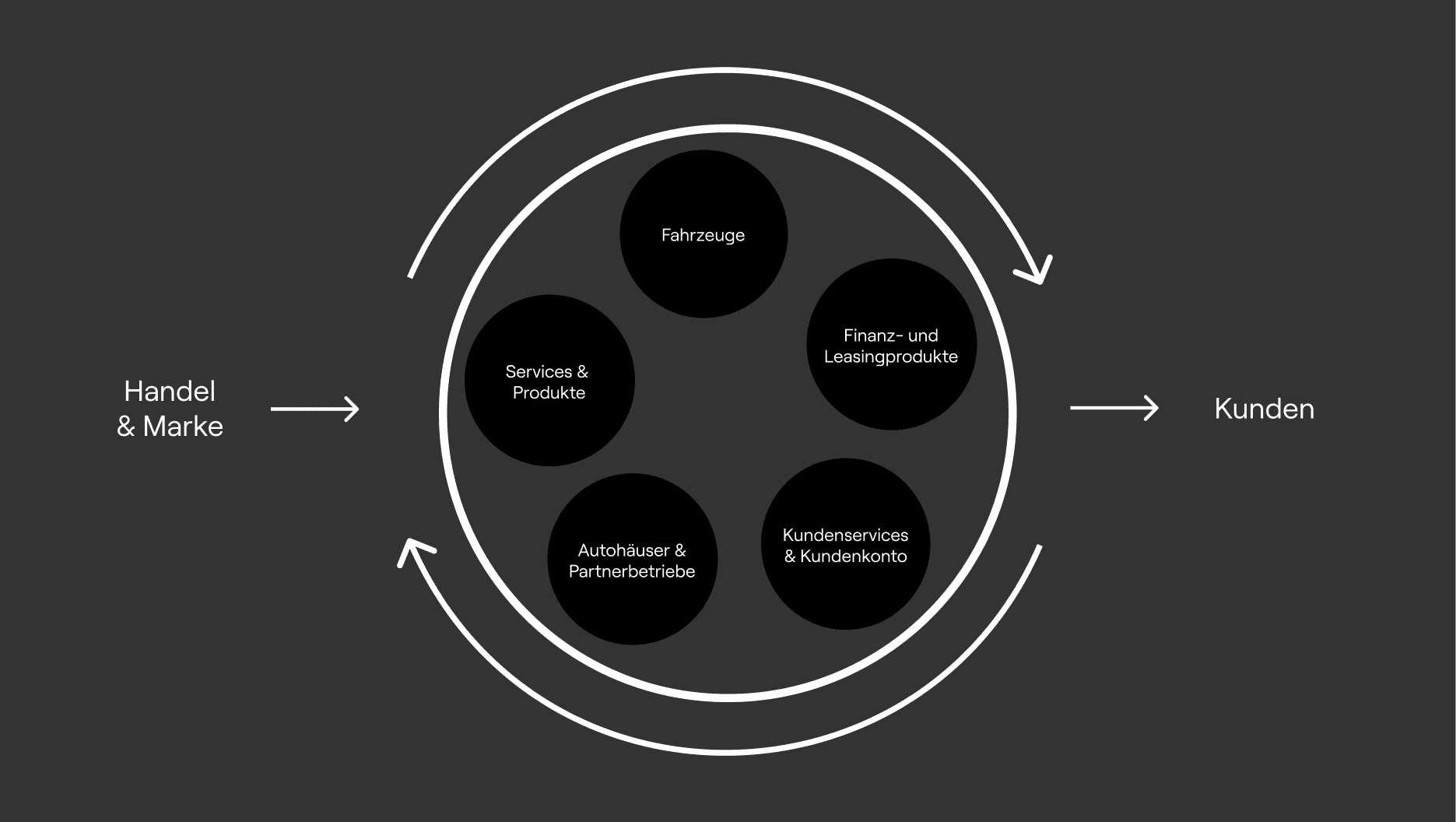
Modular components, orchestrated for genuine user relevance
Every single feature, from the vehicle marketplace and trade-in to couponing, the configurator and the local dealer search, was conceived, designed and iteratively evolved for its role in the customer journey, its usage scenarios and its contribution to conversion. CX, UX and UI design are not a decorative layer, but an integral part of the sales strategy: the interface between platform logic, brand promise and user expectations.




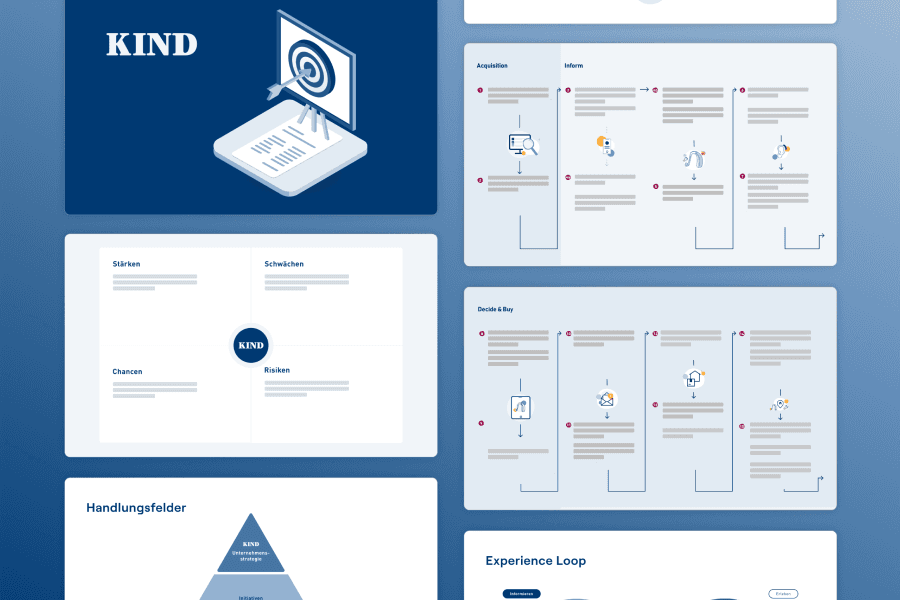
Partner integration: as simple as possible, as effective as possible
Three guiding principles underpin the integration of dealers and third parties. Automation: processes such as lead generation, communication and maintaining vehicle listings run centrally via the marketplace and are largely automated, which reduces manual effort and increases scalability. Integration: existing dealer systems are connected bidirectionally instead of creating new systems, so data remains consistent and efficiently in sync. Enablement: only where existing solutions are missing or insufficient does DAYONE develop new modules that are interoperable, user-centred and quick to deploy in dealers’ day-to-day operations. The result is a platform model that creates value for both sides: end customers find relevant offers, dealers benefit from a low-friction presence on the marketplace.

Platform logic as the foundation for innovation and transformation
The marketplace is more than a digital sales channel: it is the strategic platform that makes innovation possible. Thanks to its modular architecture, new offerings and business models, such as car subscriptions, Leasing on Demand or digital services, can be integrated quickly, tested and, if successful, scaled, without DAYONE needing to build new customer channels. The platform creates immediate business impact in the here and now and agility for the future. A website became a sales platform. A platform became a driver of innovation.
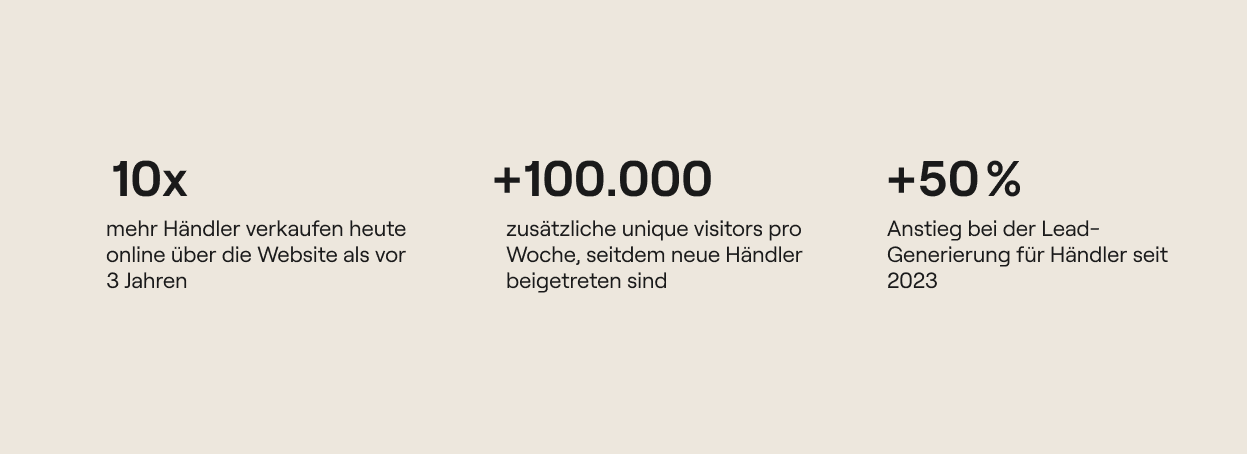
Outcome
10x more
Dealers selling online
Measurement method not specified
+100,000
Additional visitors
per week
Measurement method not specified
+50 %
Leads
Measurement method not specified
The former brand website became an omnichannel sales platform that consolidates offerings from the brand, dealers and third-party providers in a single marketplace.
Modules such as vehicle marketplace, trade-in, couponing, configurator and local dealer search run on the same platform rather than separate systems.
Our contribution to the transformation of the website
Our strategies are deliberately flexible — adaptable to market change, but clear in their objective. The basis for this is our consulting and design standard DIaaS® – Design Innovation as a Service: a collaborative approach that combines deep strategic thinking, user-centred design and operational delivery. The result is solutions with measurable value — for customers, providers and the business.
Rigorous analysis & research
We create strategic clarity through in-depth market, audience and trend analysis — the basis for robust decisions and future-proof strategies.
Collaborative strategy approach
Strategy and delivery interlock in our work: iterative, data-informed and closely aligned with all relevant stakeholders — for solutions that move things forward.
UX/UI design & requirements management
From real user needs and clear business goals we derive concrete requirements — and design experiences that don't just work, but have an effect.
Ongoing consultancy
We think with you and beyond: at a strategic as well as an operational level. As a dependable sparring partner, we bring structure, clarity and energy to complex processes.
Support all the way through delivery
We work side by side with the teams, safeguard quality in the doing and continuously drive agile development forward — until the impact is tangible.
Frequently asked questions
How does the integration of retail partners into an automotive sales platform work?
Three principles are key: automating recurring processes such as vehicle listings; integrating existing dealer systems via APIs instead of creating new parallel systems; and adding new modules only where existing solutions are lacking. This keeps the effort for individual dealers low while the platform scales centrally.
What distinguishes a digital strategy from traditional website optimisation?
A digital strategy changes the business model itself, for example through a marketplace model that aggregates offerings from multiple providers. Pure website optimisation improves existing functions without changing the underlying sales logic.
How is the contribution of individual platform modules to conversion assessed?
Each module, such as the vehicle marketplace, configurator or dealer search, is designed and iteratively evolved based on its role in the customer journey and its contribution to conversion, rather than being treated as a one-off overall project.
How can a sales platform be opened up to new business models such as car subscriptions or leasing on demand?
A modular platform architecture makes it possible to integrate new offerings quickly, test them and, if successful, scale them, without having to build new customer channels. That is what sets a platform apart from a classic website, which is built for a fixed set of functions.
More Cases


Let's move your project forward together!
Then let's get started together.
We look forward to your challenge.