Leidel & Kracht
From paper to web app: Digital production control reduces errors and boosts productivity
Digital control instead of flying blind
Paper slips give way to real-time production control. The current status of production is available at any time, rather than only becoming visible at the next check-in.
Productivity through end-to-end transparency
Issues become visible immediately, not only at the end of a step. That accelerates throughput because downtime no longer goes unnoticed.
Proactive quality assurance
Integrated checkpoints cut human error in the process and prevent costly rework before it occurs.
Investment certainty through user adoption
Co-creation with production employees secures high adoption. A system the shop floor doesn’t buy into brings no benefit, regardless of its technical quality.
Leidel & Kracht, a Cologne-based manufacturer of foam, packaging and thermoforming solutions with around 190 employees, managed its production using printed work instructions, with no real-time view of status or issues. DAYONE, together with development partner fme AG, built a role-based web app for production control. The result: a paperless production environment with clear responsibilities and shorter response times.
- Client
- Leidel & Kracht · Cologne · around 190 employees · for over 50 years
- Industry
- Manufacturing (foam, packaging and thermoforming solutions)
- Services
- Requirements analysis · Information architecture · role-based UX/UI · Prototyping
- Implemented with
- fme AG
- Outcome
- Paperless production control in real time
Starting point
Every production step at Leidel & Kracht was accompanied by printed work instructions. No one had a real-time overview of status or issues on the shop floor, leading to coordination problems, delays and unclear responsibilities.

Complex production workflows translated into intuitive, role-based UX
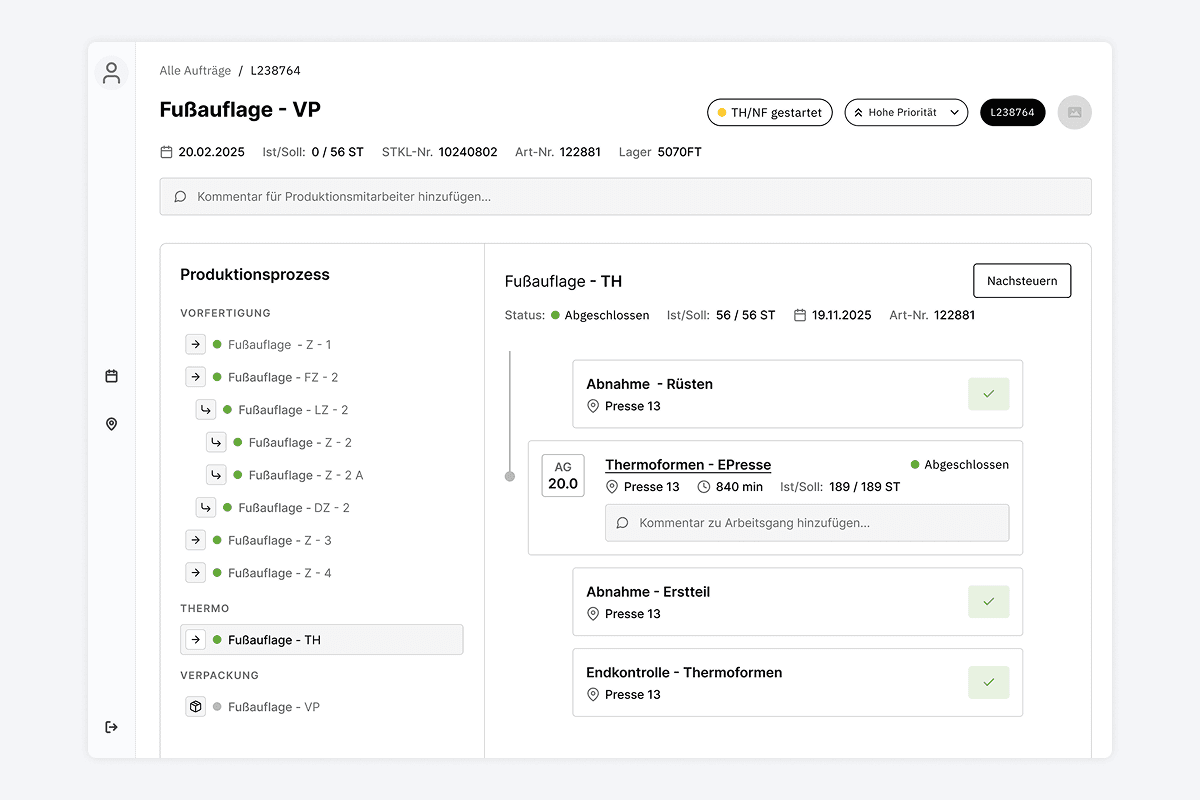
The web app turns complex production workflows into simple interfaces tailored to each role in manufacturing. Production staff and shift leaders see exactly what they need for the current step on their tablets: status, work instructions, material lists, plus supporting images and PDFs. Filters narrow down relevant orders, and shift leaders reorder the sequence of steps via drag and drop.


Close collaboration with the project team and production staff ensures it works in practice
DAYONE first interviewed employees across different roles and spent a day on the shop floor. A prototype followed quickly, which the team tested directly with employees. In short cycles, shift supervisors and production staff worked with DAYONE to determine the best way to operate each function. Issues surfaced early and were fixed immediately, which significantly increased acceptance.
Fewer process errors through end-to-end digitalisation
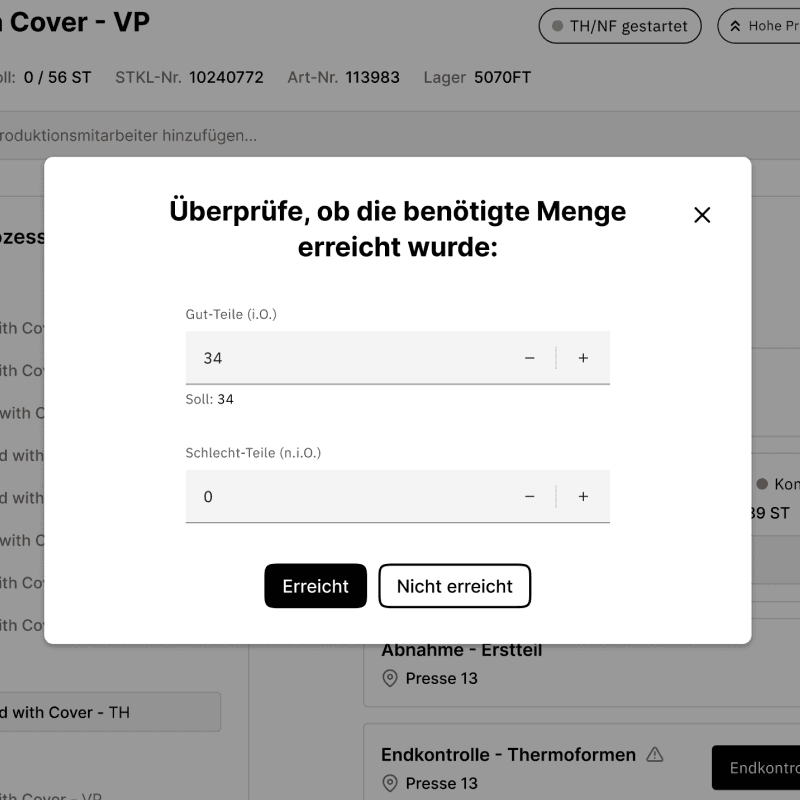
Assign, record, document, check: production runs entirely via the web app; printed paperwork is eliminated. Mandatory steps safeguard quality within the process and prevent incomplete tasks, mix-ups or rework. Shift supervisors prioritise where the work actually happens because pending approvals and issues are instantly visible. The result: faster responses and less coordination effort.


Technical implementation as a Progressive Web App with real-time capabilities and granular access control
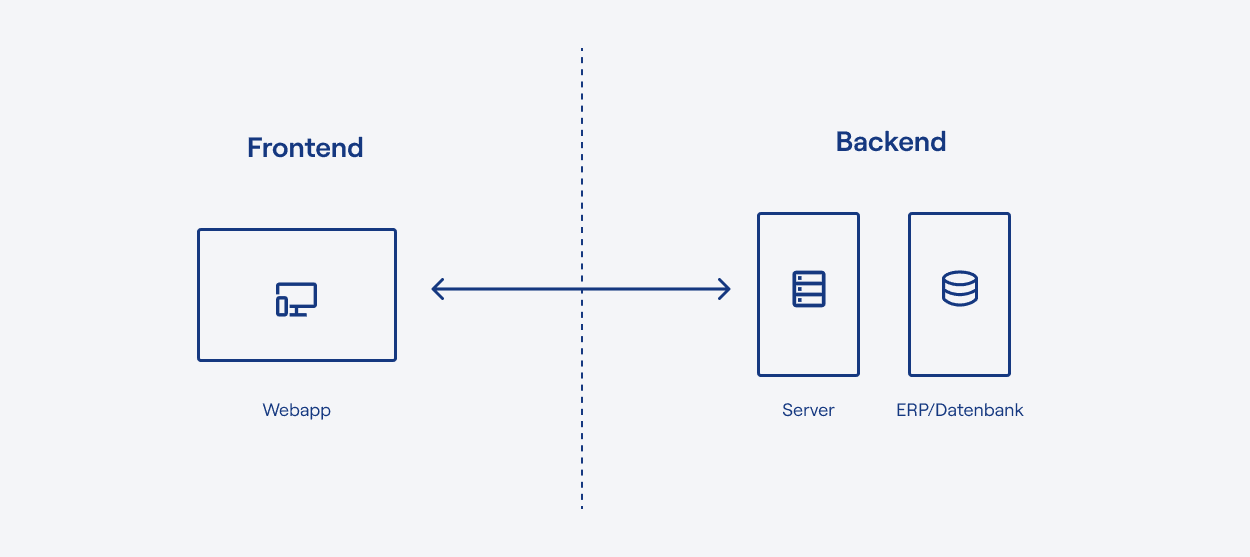
DAYONE developed the application together with development partner fme AG: a scalable web application tailored to the demands of the production environment. A clear separation of front end and back end synchronises status changes, approvals and prioritisation in real time. A role-based permissions model shows each user group only the relevant information, reducing user errors. Intelligent caching keeps the app responsive, even when network quality fluctuates. Interfaces to ERP systems ensure information flows into the existing IT landscape, and the application runs as a Progressive Web App directly on employees’ devices.
Real-time transparency in production:
The application is based on a clear separation of front end and back end and uses real-time communication to synchronise status changes, approvals and prioritisations instantly.
Role-based permissions concept
Each user group sees only the information and functions relevant to them. That reduces complexity, prevents operating errors and increases efficiency in daily work.Reliable even in demanding conditions:
Intelligent caching keeps the application responsive even when network quality fluctuates. Frequently needed data is available immediately.
Future-proof architecture:
The implementation follows modern development standards and is designed for stability, maintainability and extensibility. Interfaces to ERP systems ensure a smooth flow of information and seamless integration into existing IT landscapes.
Operation and scalability:
The application runs reliably on central server infrastructure and is used as a progressive web app directly on end devices. Automated updates and straightforward maintenance keep operations running smoothly, while the architecture remains flexibly scalable.
Outcome
Assigning, recording, documenting and checking run entirely through the web app; printed work instructions are no longer needed on the shop floor.
Mandatory steps in the system prevent incomplete steps, mix-ups and rework, instead of correcting them after the fact.
Shift supervisors see pending approvals and issues in real time and prioritise where the work is actually happening.
The app stays usable on the shop floor even when the network is unstable, because frequently needed data are cached locally.
Our Services for a Successful Collaboration
Requirements analysis and process mapping
Systematic capture of all production processes as the basis for the web app.
Information architecture design
Structuring the information architecture with clear roles, simple user guidance and purposeful journeys.
Role-based UX design
Translation of complex processes into intuitive, role-specific interfaces.
UI design and prototyping
Tested interfaces that every member of staff can understand and use straight away.
User-centred design
Close involvement of production staff and shift supervisors in the design process.
Frequently asked questions
How does an internal tool differ from off-the-shelf standard software?
An internal tool reflects an organisation’s actual workflow, rather than bending processes to fit a pre-built package. At Leidel & Kracht that meant a role-based interface for production staff and shift supervisors that matches the existing production logic exactly.
How do you ensure production staff genuinely use a new internal tool?
By helping shape it. DAYONE conducted interviews across all affected roles, visited the factory on site and tested the prototype in short cycles directly with shift supervisors and production staff. That way, buy-in happens at the start, not only through training at the end.
How do you connect an internal tool to an existing ERP system without creating a second source of truth?
Via defined interfaces that ensure information flows in both directions. The key is that the new application integrates into the existing IT landscape rather than maintaining its own parallel data.
What is the hardest part of replacing paper-based processes in manufacturing?
Not the technology, but the role logic. Paper shows everyone the same information. A digital control system, by contrast, must define which role gets which information and which permissions, that is process work, not development work.
Why is a Progressive Web App suitable for use on the shop floor?
Because updates arrive automatically on all tablets without the detour via an app store, and the application must remain usable even when Wi‑Fi on the shop floor is unstable. Intelligent caching keeps frequently needed data locally and solves exactly that problem.


Let's move your project forward together!
We look forward to your challenge.