Decoding the Experience Loop: understanding and shaping customer experiences

Nico Wohlgemuth
Managing Partner DAYONE
Why do some companies manage to build a loyal customer base while others have to acquire new customers continuously? The answer to this crucial question often lies in a fundamental element of the business — the customer experience.
Customer requirements and expectations are constantly changing, and keeping up with them makes it crucial not only to win new customers but also to retain existing ones. That is often easier said than done. Companies face the challenge of not only offering great products and services, but also of taking responsibility for their customers having a positive and lasting experience with them.
Customer loyalty has long since stopped depending on product quality alone. It is about the overall experience associated with a brand or a company. Customers expect seamless interactions, personalised service and convenient use of products and services.
How can companies make sure they offer the best possible customer experience? How do new customers become loyal users? It comes down to the way the Experience Loop is understood and used to shape the customer experience.
In this article:
The traditional customer funnel, or the time "before the Experience Loop"
The Experience Loop as a holistic view of the customer experience
The individual phases of the Experience Loop
Applying the Experience Loop correctly
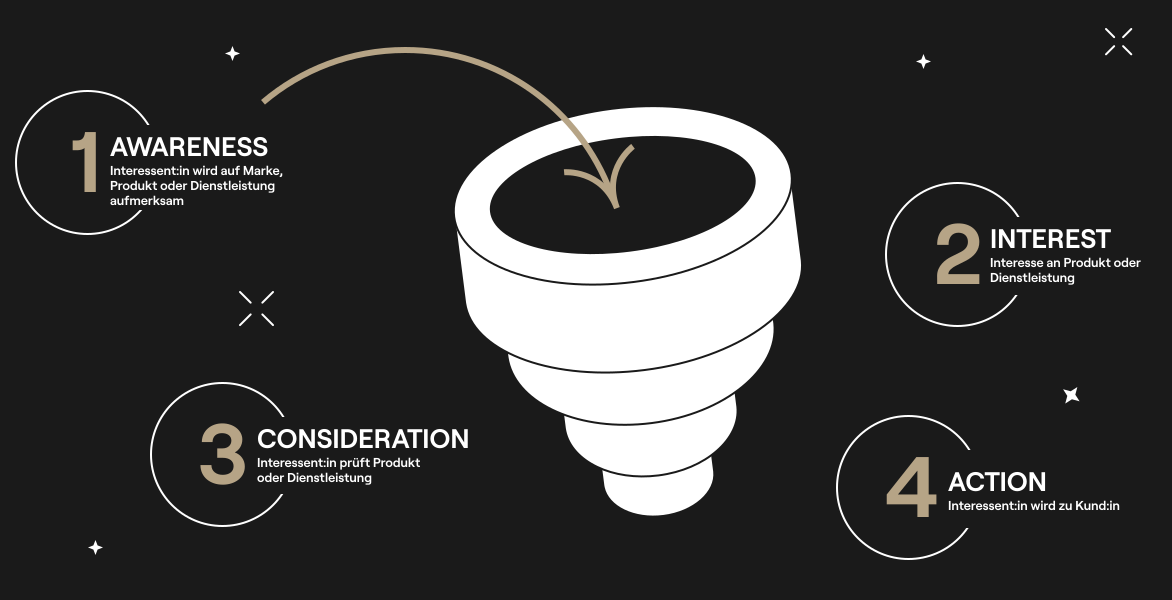
The traditional funnel, or the time "before the Experience Loop"
To understand why we use the Experience Loop, and why it represents a shift in the mindset of marketing and product leaders, we first have to look back a few years: to the early 2000s and how customer experiences with a company were understood and designed back then.
The traditional customer funnel is aimed at people who do not yet know that they have a need or a "pain" (a specific problem a customer has) and who therefore do not yet know the product or company that meets that need. For these people, marketing leaders plan the interactions required along the traditional funnel, and the measures that follow from them, in order to make people aware of the product and convert them into new customers.
This traditional funnel has one decisive drawback: it does not grasp the customer experience holistically but stops at the point where customers decide to buy or use a product.
Today we know that the customer experience obviously does not stop there. It is important to keep customer satisfaction high after use begins, so that customers stay loyal to the company in the long term.
McKinsey recognised this in 2009 too and therefore "invented", in place of the linear funnel, a self-contained Experience Loop.
The Experience Loop as a holistic view of the customer experience
What does the Experience Loop look like?
To grasp the customer experience holistically, the Experience Loop does not stop at the moment of purchase but also examines the journey afterwards:
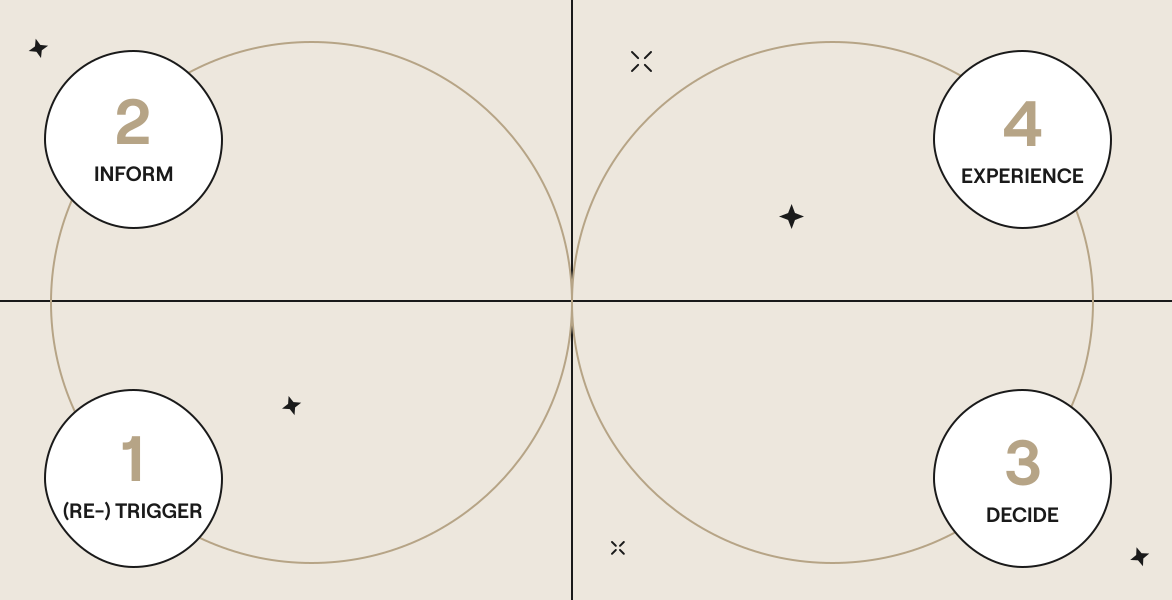
In the trigger phase we make customers aware of a need and of our product. In the inform phase they then engage with it more deeply, before the decide phase brings the final decision and the transaction (a purchase or app download, for example). Where the traditional funnel stops, the loop continues with the experience phase, which reflects using the product. In the re-trigger phase, customers are made aware of further needs and the services or products that go with them. The Experience Loop starts again.
Alongside new customers, existing customers therefore also come into focus for CX (customer experience) measures and activities. That makes commercial sense, because studies show that the Cost per Aquisition - that is, the costs incurred to move customers to a specific action such as a purchase - are considerably lower for existing customers than for new ones.
Also, the Customer Lifetime Value, that is the revenue a company can generate from a single customer, is increased by focusing on existing customers.
Building on this holistic view of the customer experience and the mindset that comes with it, marketing and product leaders can plan, manage and optimise their CX activities comprehensively.
The Experience Loop provides the strategic basis for this by illustrating the customer experience and creating a shared understanding among everyone involved.
The greatest value in creating an Experience Loop lies in building a shared understanding of the current or intended customer experience. The Experience Loop is very well suited to this because it is easy to take in at a glance.
YEARTEN
After 10 years of DAYONE, we’re sharing our knowledge: how to not just lead teams, but empower them. A deep look behind the scenes of our brand, values, culture, and ways of working.
Discover how we organize ourselves, find and develop talent, and what we’ve learned from the past to shape the future.

What do the individual phases involve in detail?
The phases ask the following questions:
Trigger
How do customers become aware of a need? And of the product that meets it?
→ Marketing activities are typically placed here
Inform
How do customers find out about the product? How are they inspired to engage with it more deeply? How do they evaluate whether the product might fit the need?
→ The inform phase increasingly takes place purely digitally. Even so, physical touchpoints should not be forgotten.
Decide
How do customers decide on a product? Which steps do they have to go through? How are they supported during that decision process?
Experience
What do customers do with the product they have bought? What ongoing points of interaction with the company are there? How do customers build loyalty to a product and a company?
→ It is also worth considering what influences the product experience outside actual use.
Re-Trigger
How do customers become aware of the company's other offerings? Which further needs can the company meet?
→ Marketing activities are typically placed here as well. Unlike the original trigger phase, however, they usually take place on different channels, because we are now addressing existing customers.
When is the Experience Loop used?
Because the Experience Loop in its basic form is at first only a model, it can be used for a variety of scenarios.
Analysis: capturing the current state
At the start of a project it is important to understand how customers currently interact with a company. The Experience Loop makes it possible to identify knowledge gaps in the current state, to spot general gaps in the customer experience (in other words, where the company is not yet taking action) and to discuss potential for improving CX. Stakeholders' ideas and expectations can be captured along the loop.
Experience strategy: defining the intended state
Part of an experience strategy is identifying fields of action and concrete measures with the aim of offering the best possible customer experience and thereby also achieving existing business goals. The Experience Loop can be used here to describe the intended state of the customer experience. Identified measures are placed along the loop, giving an outlook on what is to be achieved.
Scaling: identifying the next features and steps
Provided a strategy exists, the Experience Loop can be used within a team to derive a feature roadmap and the next steps that go with it. To do that, the team looks at the tasks a channel or touchpoint performs in the customer experience today (in other words, the Value Proposition) and which should be taken on in future. From this, features can be identified and prioritised into a roadmap. The Experience Loop can also be used here as a basis for discussing subsequent research: where do we already have data, and where is it missing?
Can the Experience Loop be extended?
The individual phases of the Experience Loop can be detailed further. That might look like this:
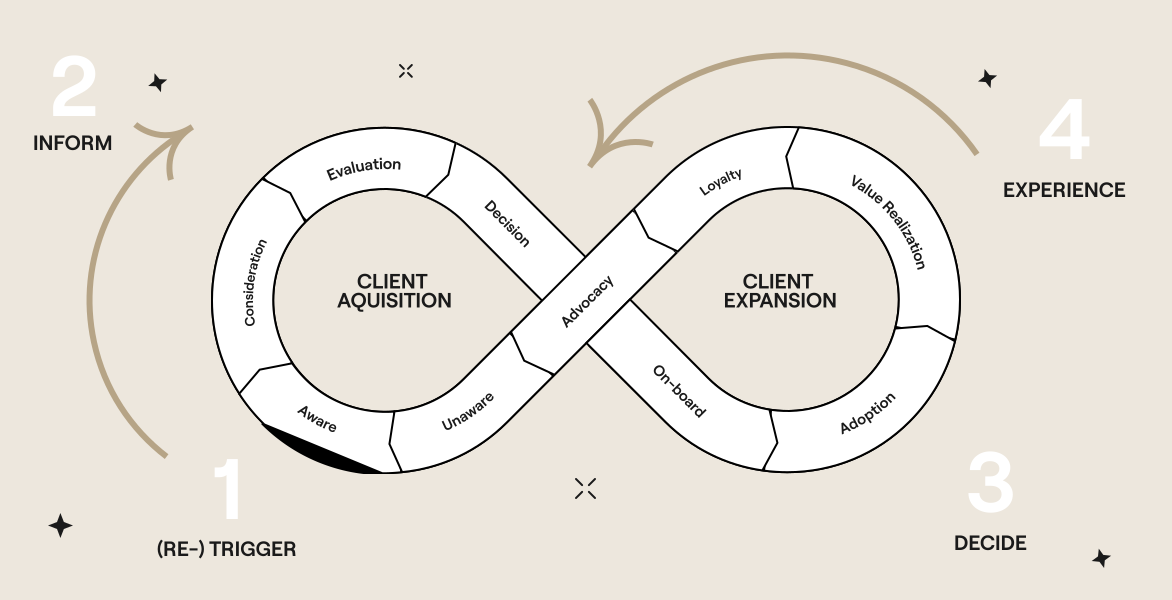
Further classification makes it possible to identify customer challenges and potential more precisely, because the individual overarching phases can have several dimensions that contribute to their success. Dedicated strategies and the measures built on them can then be developed to support customers as well as possible. The sub-phases shown above are not universally applicable; they serve as a starting point and can be adapted to requirements.
Further information can also be shown in the Experience Loop, such as:
Touchpoints and channels: Where do the interactions take place? For individual phases, are there touchpoints or channels that take the "lead" because they are better suited to certain interactions?
Responsible teams: If a company has, or wants to build, several teams working on the customer experience, it can map out which phases or interactions each team is responsible for.
KPIs: Which business-relevant metrics do companies use to measure success and the customer experience? These can be placed at the points relevant to achieving them, to add the business perspective.
Are there prerequisites for applying the Experience Loop?
Before applying the Experience Loop, it must be clear which audience or customer segment it is being worked on for, because it can look different for different segments. It must also be clarified whether the current or an intended state is to be mapped.
Finally: where are the challenges in applying the Experience Loop?
Companies that use the Experience Loop mainly run into the following two challenges:
1. Finding the right altitude
The Experience Loop aims to give a holistic overview of the customer experience. That means it cannot offer "epic" levels of detail, as is possible for example with individual Customer Journeys is possible. It is therefore important to find the right altitude, so as not to sink into detailed discussions.
2. Carrying the Experience Loop into the teams
The loop is often used by overall product owners and product managers for the strategic planning of measures.
But because the Experience Loop is at first "only" a model, it is important to carry the ideas and hypotheses that come with it into the teams, so that every team member understands and supports them. Operationalisation is therefore at least as important.
The Experience Loop opens up a comprehensive perspective on designing customer experiences. It illustrates the customer experience in five phases, from sparking interest to renewal. This view directs attention not only to winning new customers but also to retaining existing ones. That makes commercial sense, because the cost of retaining existing customers is lower than the cost of acquiring new ones. At the same time, long-term revenue rises. Marketing and product leaders can use this approach to plan and optimise comprehensively. The Experience Loop creates a shared understanding and forms the strategic basis for successful customer experiences.